A cautious stroll through the dark forest.
Navigating the Internet in 2025.

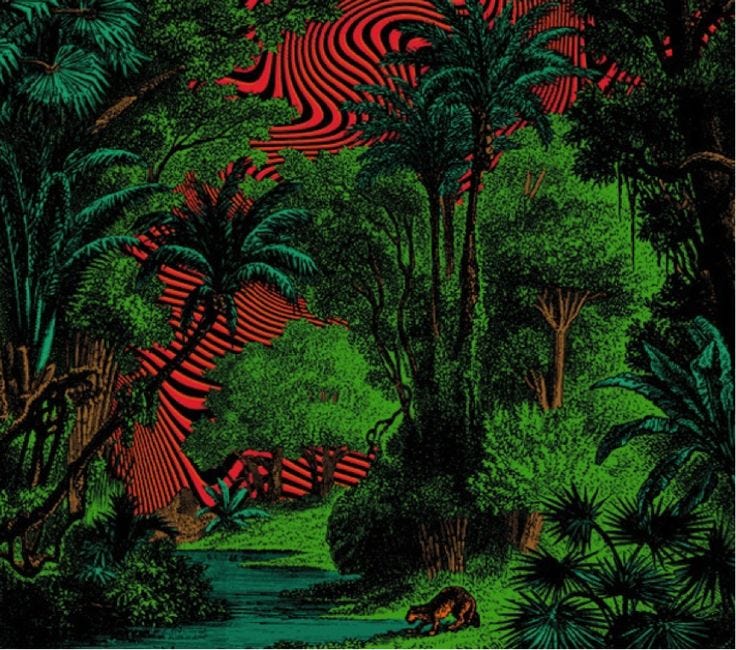
Up until about a fifteen years ago, the most common way to express that you were using the Internet1 was by saying you were “surfing [the web].” The Internet felt as boundless, ephemeral, and manifest as crests and troughs on the surface of the ocean. If you caught a good wave, you were in for a short-lived thrill, after which you would safely paddle back to the shores of real-life.
Over the years, typhoons and tsunamis wrecked the coastline. They degraded the boundary between land and sea and allowed water to seep into our soil. Our world became half-forest and half-river, a dark mangrove teeming with monsters unknown. We “browse”2 to survive and make sure we keep our heads above the water, lest we are swept into faraway seas.
“The universe is a dark forest. Every civilization is an armed hunter stalking through the trees like a ghost, gently pushing aside branches that block the path and trying to tread without sound. Even breathing is done with care. The hunter has to be careful, because everywhere in the forest are stealthy hunters like him. If he finds other life—another hunter, an angel or a demon, a delicate infant or a tottering old man, a fairy or a demigod—there’s only one thing he can do: open fire and eliminate them.
In this forest, hell is other people.” 3
In our rapidly-changing climate, “surfing” feels too leisurely, too incidental to capture its all-consuming, hyper-vigilant nature. And now, the Internet is a given, so ubiquitous it would be like mentioning that you’re “breathing the air”. The in-between, I think, is a word already present in our online lexicon—‘to navigate’.
Yes, ‘navigating the Internet’ is a phrase as old as the Internet itself, but it never really reached the levels of casual-cool that “surfing” and “browsing” did. I mean, is the Internet even cool anymore?


It’s not like it’s lame either. The Internet has evolved past its nascent youthful connotation, growing up while a generation and a half of adults did too. Now we face a wild, overgrown Internet, unregulated and labyrinthine, teeming with bandits, pirates and inhuman agents of chaos. We are not valiant explorers, and we shouldn’t be. There is nothing to gain from doing so.
The dead hand
Theorists and public figures from a variety of backgrounds, like computer science, sociology, literature, art, business, and marketing, have been building upon the dark forest theory of the Internet. Initially proposed by author Cixin Liu as a solution to the Fermi paradox, he describes the conditions of a vast space with limited resources, filled with pockets of life that expand to survive.
In this space, at least one life form is bound to be aggressive, antisocial and dangerous to others. Why not check their legitimacy before trusting them? Because, on the off-chance that the entity has technology more sophisticated than yours, then a) you can be easily fooled and b) even the act of checking is tantamount to exposing yourself for attack.
Say you click on an innocuous-looking hyperlink, only to be confronted with a shady gambling website. In the few seconds it takes for you to close the window, the host has collected all the data they need. More nefarious sites could set up mirror sites with a veneer of authenticity that you scroll through while they leisurely track and steal your info, or download a virus that bricks your device, or sell your data to the highest bidder. The possibilities are endless, and far beyond what the average Internet user can fathom.
Similarly, broadcasting yourself on the Internet can attract the good, yes, but also the terrible, horrible, no good, very bad. The best solution, then, is to keep mum. The only way to survive is to establish chains of suspicion, softly tread well-worn paths, take what you need, and get out as fast as you can.
Go touch some grass
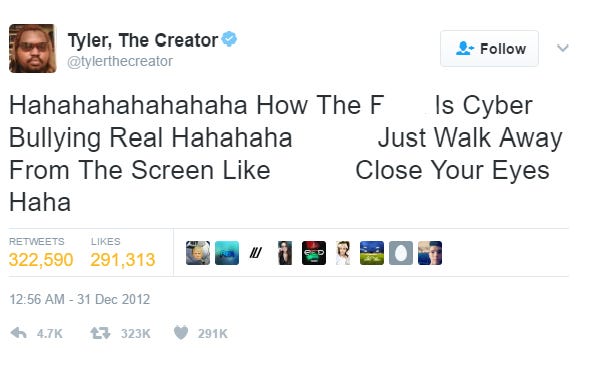
The big difference applying the dark forest theory to the Internet, as opposed to the original setting of space, is that we are forced to exist in space. We are not, at least literally, forced to be on the Internet. But that’s a pedantic way of looking at it—Tyler the Creator’s sentiment does not apply today, thirteen years later. Now, every single service needed to live comfortably within our society, across the world, is linked to the Internet. So who are you, in this realm?
In one of the many articles I’ve been devouring on this topic, scholar Bogna Konior’s 2020 essay entitled ‘The Dark Forest Theory of the Internet’ pushes this thought experiment to its extremes, coming to the following conclusions:
To signal “safe” sociality, each user needs to be legible in her self-representational practice; everyone needs to make themselves known. The forest-system needs to be able to read us, as do the other users…But this legibility means that our coordinates are exposed. We can be seen, attacked, and governed…The more we are seen, the easier for us to become a target.
We hallucinate the self within [the dark forest’s] mechanism, but the process has little care for the self. The interface of the forest might read us well, its plants releasing the titillating hallucinatory gas of subjectivity. Each node in the cybernetic chain of suspicion, sustained by the communicative interface…
Once the dark forest is set in motion, we might miss what’s behind the thick fog of subjectivity—an automated extraction process that reduces every single one of us to the complexity we generate…playing one node against the other, designing patterns of disorder. In this forest, one better stay silent or prepare for conflict.
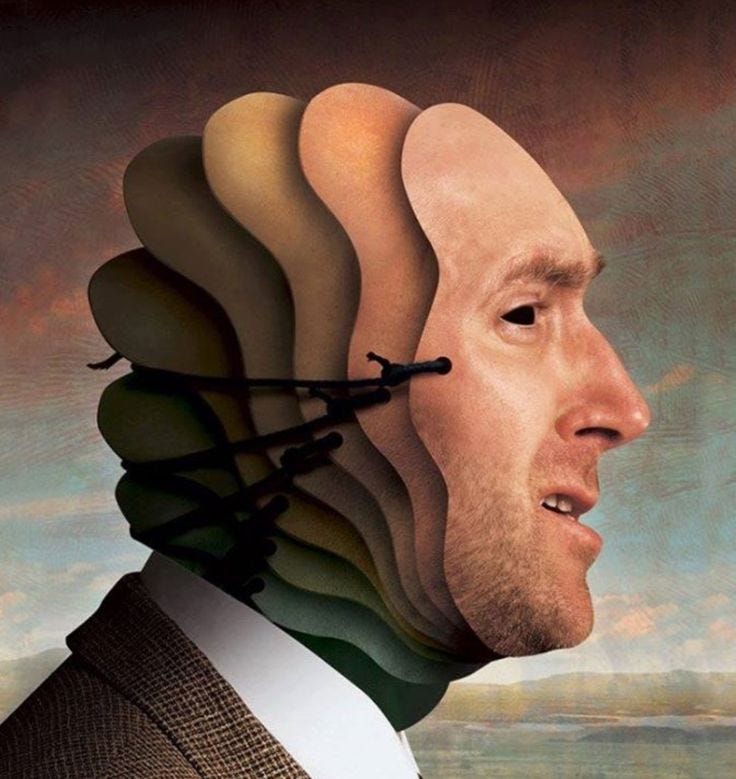
And this theorisation was before the rise of AI. In 2025, the complexity has increased by order of magnitude. The latest resident of the dark forest is the not-quite-humans wearing a mask of benevolence. A mask on top of a mask.
The next time you’re out navigating the Internet, slashing down trees in a desperate big to unearth treasure, while you dodge homunculi, predators, vampires, and sinkholes, remember that the trees themselves, that provide the air you breathe, are trying to seduce you. The dark forest is delighted that you’re here, and does not want you to leave. Why should it? You’d make an excellent meal.
Yours, chronically online,
Khushi
P.S. This is definitely a shorter, relatively less in-depth piece, but I’m trying to get back in the habit of regularly writing by writing smaller chunks. Maybe this could be a part of a series...
“To use” the Internet is also a remnant of the bygone era of dial-up. “It’s my turn to use the Internet!”
browse /braʊz/ verb
(of an animal) feed on leaves, twigs, or other high-growing vegetation.
eg. “they reach upward to browse on bushes”
Liu, Cixin. The Dark Forest.
Loved the forest analogy, Khushi! It’s murky and trapping, indeed.